
Labor, time, and money are the inputs, and riding, manure, and bills are the outputs of having horses. When equestrians can spot and stop waste, it’s great for our pocketbooks and gives us more time to do other things, like cleaning tack. It’s a bonus then to reduce hay waste and improve the quality of your horse’s life by ensuring their forage ends up where it belongs, in the manure pile.
Key Highlights
- Hay quality and slow feeding systems influence how much forage waste accumulates.
- Storing forage for minimal moisture and maximum air circulation is best.
- Health issues, like dental problems and gastric ulcers, influence how much forage is wasted.
- Be strategic about the type of feeder you choose and its location.

What Factors Cause Hay Waste?
- There are many reasons, of course, that your horse decides they would rather sleep, poop, or stand on their food. Detective your way into the best solutions to reduce hay waste by narrowing down all possibilities.
Barn management
- Storage areas are too exposed or too contained.
- The hay is too stemmy or not palatable for your horse. This may be a supply issue or a storage issue.
- Mold and excessive dust contaminate the area. We all hope that moldy hay is ignored, but it might not be.
- Hay nets are not hung at comfortable heights. Horses do best when they ground-feed.
- Soaked or steamed forage has fermented. This rancid smell and taste discourages eating.
- There are tastier options available. Sometimes this is pasture, and sometimes it’s fencing.
Pasture management and large bales
- Tossing hay without a strategy.
- Not minding mud and worn areas.
- Offering too much forage.
- Herd shenanigans that play through piles.
Horse health causes
- Poor dental health creates chewing pain and wasted food. If the problem is more obvious and creates quidding, this is the email equivalent of your horse asking for your vet.
- Gastric ulcers are painful with or without food in the stomach.
- The urge to dunk hay makes some horses drag bites of forage to the nearest water source, leaving a trail behind.
- All of these possible reasons need your vet’s assistance for diagnosis and treatment. Then pair that with any management changes you can make to help reduce hay waste.
What Wasted Hay Costs You
- It’s an eye-opener when you are scooping forage bits with manure and tossing it. But the hidden costs can go deeper.
Personal and labor costs
- Wasted forage is wasted money. You are paying more to keep your horses fed when forage ends up as trash or fertilizer.
- Time is valuable. There is extra labor needed to clean up the excess and restock the barn. In some cases, you are paying for someone else’s labor and time, which might impact you more than your time.
- Your horse pays a nutritional cost. Bits of stem, which are not as tasty as the leafy parts of hay, provide valuable fiber. If weight management becomes an issue, you could spend more on commercial feeds or supplements to provide calories and nutrients.
Environmental impact
- Wasted hay on your farm might end up ground into the earth, holding the mud together, or diligently picked up and composted. In some ways, that might be good for the local environment.
- In the much broader sense, consider the environmental costs of making hay. Water feeds the grasses, gas powers the tractors and rigs to get it baled and shipped, and it goes on and on. Waste is waste, and it tracks back to the field and farmer.
Slow Feeder Systems Reduce Hay Waste
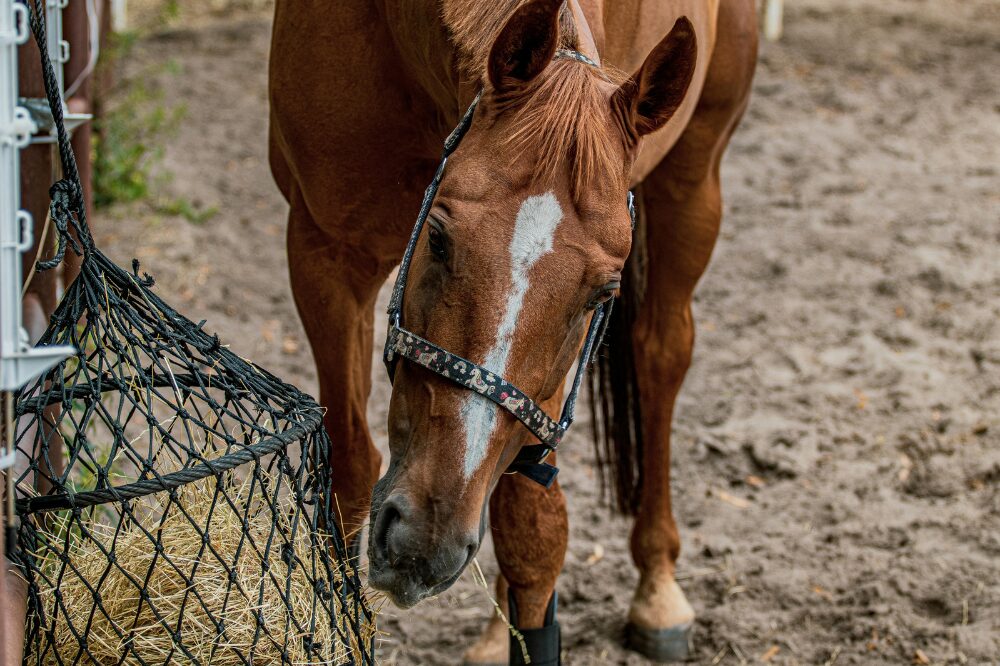
- Finding the best slow-feeding system for an individual or the herd boils down to how big the openings are and how the feeding process works at your barn. Of course, there is always going to be the one horse that didn’t get the email about how to use a slow feeder.
- Feeding systems that allow the feeder to shrink as your horse eats are often best. This reduces frustration. Sometimes larger openings are best. Other times, opt for smaller openings. The type of hay you stuff in there matters, too.
You’ll want a system that:
- Limits the “bite-size” of forage.
- Remains clever-horse-proof.
- Keeps the forage and ground separated. This could be the feeder’s job, or use mats.
- Allows your horse to eat from ground level.
- You may not find something that checks those boxes, but you can always try more than one configuration. Horses may have a preference, too.
Tips for Choosing the Right Hay Feeder for Your Horse Setup
- Analyze what problems need solving. Are the food bits getting in the mud, is everything too dusty, are there squabbles over who gets to eat?
- Ideally, your slow feeding design should keep most of the forage contained, and any spillage should be protected from grinding into the ground. It could be as simple as a net on a fence with a mat under it.
- Also consider whether your horse needs more movement. Adding multiple stations around the paddocks can help.
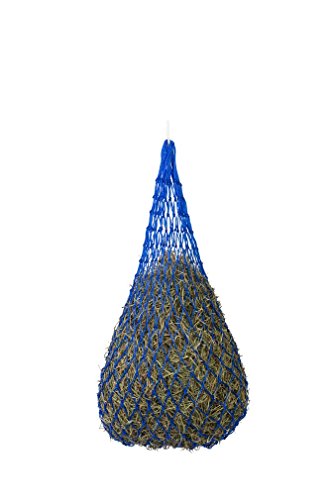
- Decide whether slow-feeding stations need to be a hard structure, like a box with a woven top or grate, or a softer system like a net, bag, or giant pillow. Feeder designs vary, and you may need to try a few.
- Add more feeding stations than there are horses.
- Avoid anything that looks like your horse could get stuck, like the giant metal livestock hoops usually seen around cattle.
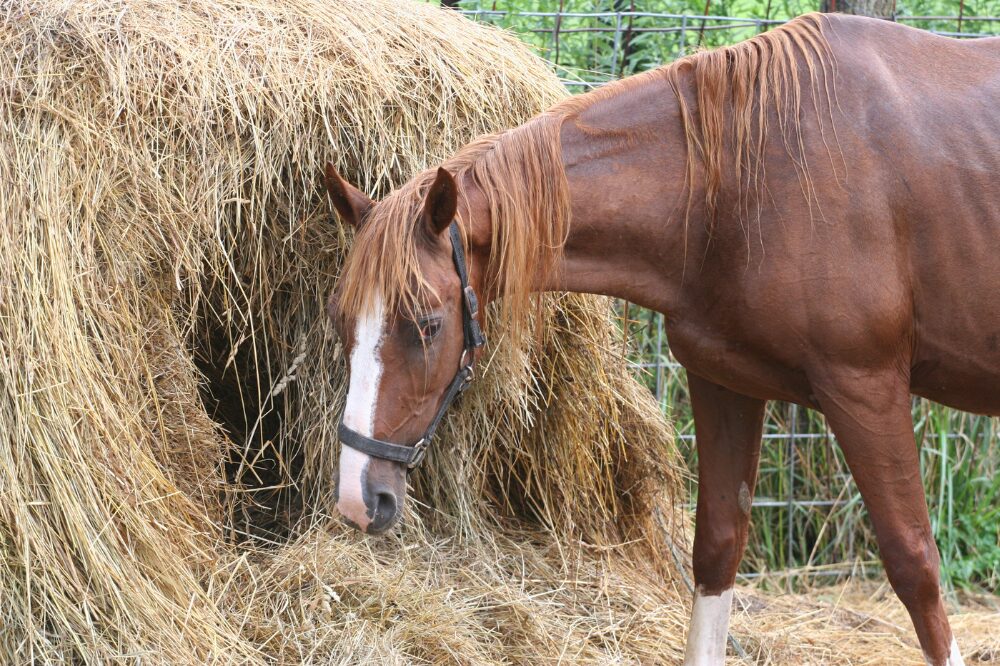
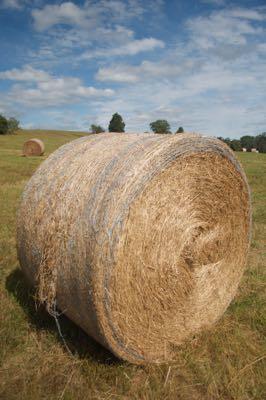
- Large round bales have their own challenges, as the tops can form a crust or hay hay. Horses naturally want to eat below that, and a huge hay net prevents that. However, most horses with free-choice hay start eating slower on their own. The problem is the dropped waste, which is often a trade-off for bulk pricing.
How to Minimize Hay Waste and Save Money
- You can also modify some barn management routines to reduce hay waste. It starts with the forage itself. The nutrition and calories in forage matter just as much as the type of hay feeder. Your horse’s health and body weight help determine how much forage they need.
Choose the best hay when possible
- Buy local when possible. Where the climate allows, many farmers bale hay for neighboring farms. More often than not, you’ll develop a relationship with them that allows for productive feedback. Your needs may influence their growing plans to maximize the best quality forage.
- Not everyone has a neighbor that grows and bales locally. Perhaps you have more than one feed option in your area? It’s not a terrible idea to shop around every time you need to restock.
- Store as much as you can when it’s nutritious and delicious. This buys you some time to find more, and helps prevent digestive upsets when new hay arrives. You’ll have plenty to mix in for a smooth transition.
Tips for hay storage – inside and outside
- Storing forage is simple when you can control moisture and airflow. You want low moisture and airflow around to prevent spoilage and mold.
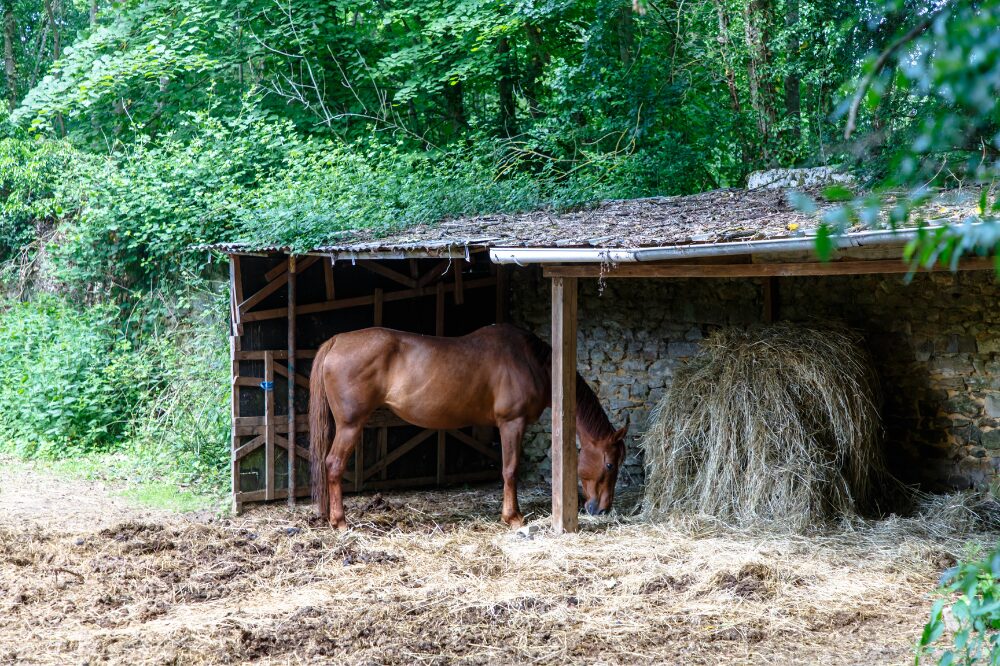
- Indoor hay storage is best to keep it from the elements. Even though it’s inside a shed or barn, use pallets or tires as a base to boost airflow.
- Many barns store feeds away from the barn to maximize the distance between equine and kindling. Fire will consume hay in a barn like it’s going out of style. Hay lofts require diligent monitoring and a fire safety plan that includes safe electrical wiring protected from hay bits and dust.
- The same principles apply to outside storage. Depending on location, it might be an open-faced shed or fully enclosed building, or a pile in the back corner. Either way, keep the hay shielded from rain and snow while propping it away from the floor and walls.
- Stack bales in a pyramid shape for open storage outside. When covered with a tarp to fend off rain and snow, the water naturally drips down. This is when raising those bales off the ground becomes vital.
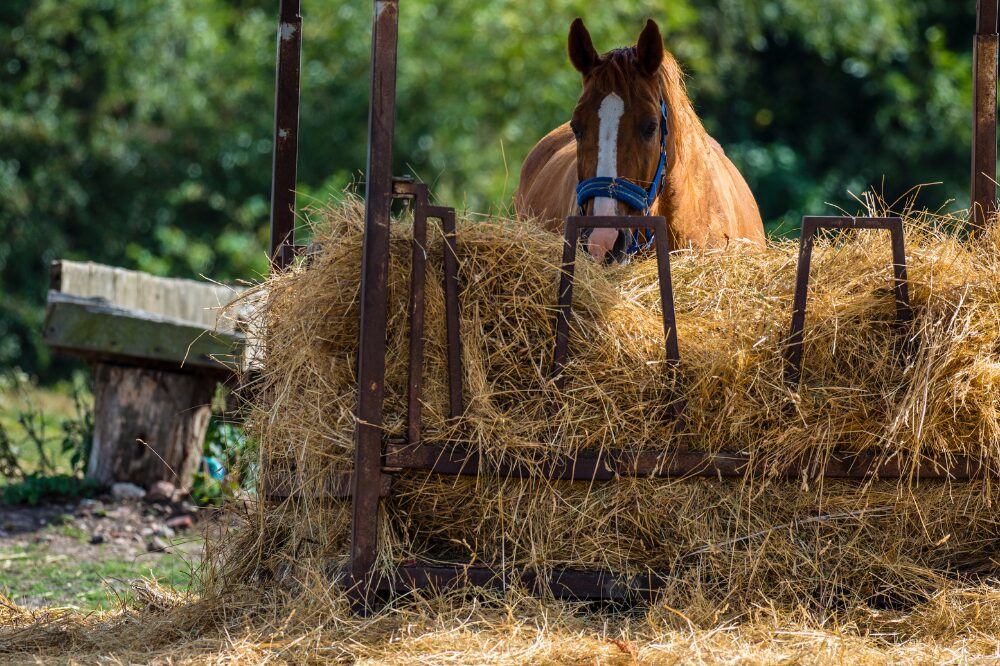
Is this a future vet bill?
Location and footing matter
In the barn
- Choosing where to hang a simple net or ring feeder comes down to which corner to use. Keeping forage away from typical urine and manure spots is the best place to start. You can encourage this by keeping the area under the feeding station free of bedding.
- Then watch your horse eating, noticing how they maneuver their necks. Adjust for comfort.
- Also notice their reactions, if any, to eating next to another horse. Some may want some more privacy to feel less threatened.
- For dunkers, keep their feed and water close together. This minimizes dropped hay.
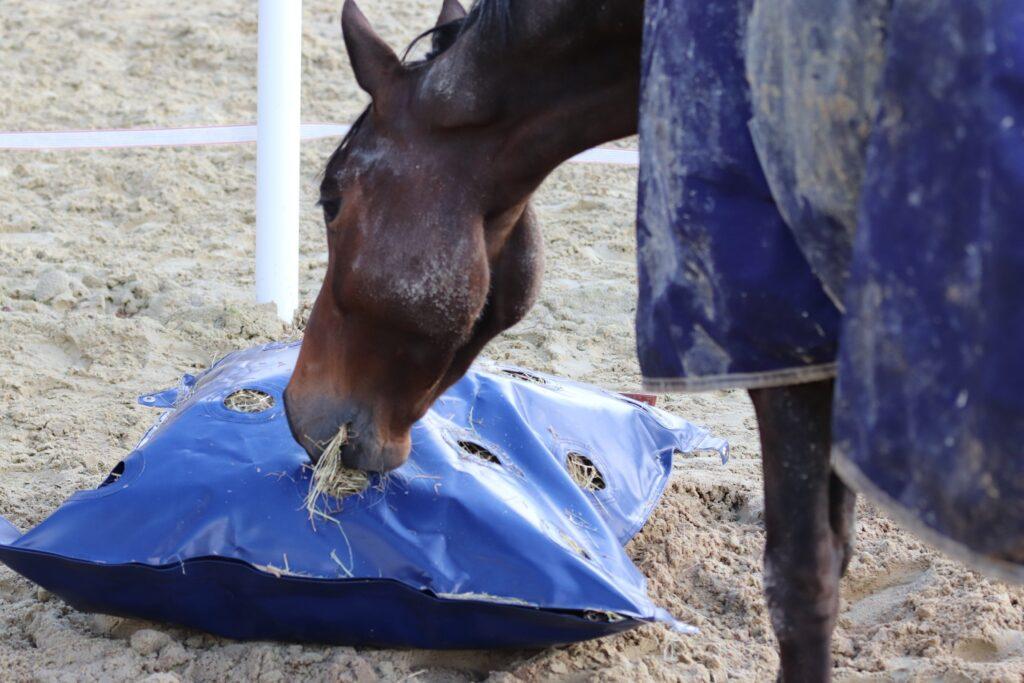
Best practices for outside feeding
- Feed where the forage can stay dry. If any spills, give it a good landing spot like mats or anywhere that isn’t a high-traffic area, like gates and waterers.
- Supply more feeding stations than horses.
- If mud is a frequent visitor, consider adding gravel to a higher spot as a feeding location.
- Account for dunkers here, too. You may need to add another water source.
- Decide if you want feed bags to roll around. While this encourages movement, it’s not ideal in all situations. Most nets and bags can be easily secured to a fixed spot, too.
Finding solutions to your horse’s budget breakers will always involve some trial and error. Things may change from season to season, or with a new delivery. Keep your options open and experiment with different slow feeders to find the best ways to reduce hay waste.
FAQ’s
2 sizes of this slow-feeding hanging hay toy - snack size holds a few flakes, and the half size holds 1/2 bale. There's also an XL that ground feeds.
Use code 15PROEQUINE for sitewide savings on slow feeders and more.

One side of this innovative slow feeder is solid - perfect for pastures! It will hold a small bale of hay.
Use code 15PROEQUINE for sitewide savings on slow feeders and more.


![Hay Nets for Horses 6x6 Fits Bales [4x4-6x6] OR [3x3x8-4x4x8], Hay Bag for Livestock](https://m.media-amazon.com/images/I/61OS5f5OuRL._SL500_.jpg)