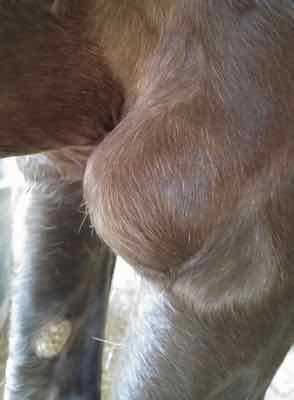
Tah-dah! This is a large shoe boil. Thanks to Diane D. for the photo!
Horse Elbow Anatomy and Bursitis
- As bones, connective tissues, and muscles meet in the body, bursae are there to reduce friction during movement. Bursae are fluid-filled sacs that also cushion the surrounding tissues, protecting and supporting the joints.
- When bursae are irritated, they often swell, creating bursitis. Some equines have congenital bursitis, in which they are born with swelling of the bursa, or acquired bursitis, in which swelling develops.
- For horses, you may see this in elbows, hocks, and shoulders. The olecranon bursa within the elbow joint is the shoe boil. It’s soft and squishy to the touch.
- Your horse may feel nothing, or they might have significant pain and lameness, depending on the circumstances.
What Causes This Swelling and Bursitis of the Elbow?
- These pockets of swelling are commonly caused by the heel of the hoof or horseshoe pressing into the elbow while your horse is lying down. Often, shoe boils feel like pudding under the skin. Your horse will move normally, and in some cases, the boil will decrease in size after exercise.
- Or, your horse rests their elbow on a hard surface or even an area sparse of shavings or bedding.
- Some horses may sustain a kick or other injury to the area, which can immediately cause discomfort and bursal inflammation.
- The damaged area may, over time, fill with fluid or blood, creating a seroma or hematoma. A seroma is a pocket of blood plasma that accumulates in the tissue due to leakage from damaged blood vessels. A hematoma is similar, but it is a pocket of blood that has leaked from damaged vessels. This seroma or hematoma is what you feel and see around the elbow of your horse.
- Occasionally, a shoe boil becomes infected, likely through a small cut or abrasion to the skin where the heel of the shoe or hoof rubs your horse. In those severe cases, a call to your veterinarian is mandatory, as fever, lameness, and serious infections can follow.
Read more about bursitis here, from a vet handbook.

Check out the front hoof – tucked up against the elbow.
Talk to Your Veterinarian for a Treatment Plan and Boil Prevention
Your trusty DVM should see your horse, even if you suspect everything is fine.
Your vet’s plan – addressing inflammation, antibiotics, and drainage
- Your vet can drain these nodules, which may prevent further trauma, mainly if caused by a hoof or horseshoe.
- Your veterinarian can also administer corticosteroid injections to the affected area to reduce inflammation and, subsequently, pain. Oral NSAIDs like bute or banamine may help, too.
- This is a fairly common condition, and you’ll want your vet to help you get ahead of complications, such as septic bursitis. This condition is downright awful, with the area becoming infected, leading to severe pain, fever, and overall danger to your horse. Surgery may be necessary in extreme cases.
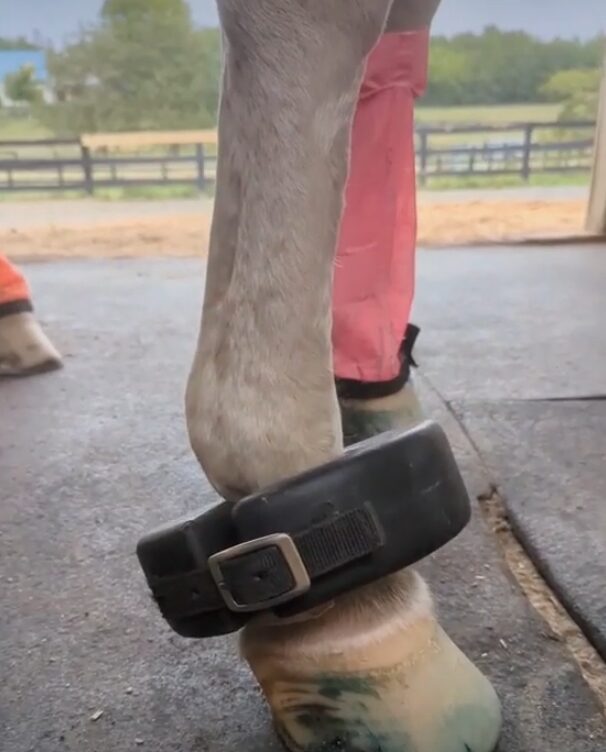
Your care plan – bedding, hoof care, and shoe boil boots
- Your treatment plan is to help your horse’s hoof and elbow spend time apart. You can:
- Improve any uneven ground that creates weird sleeping positions.
- Add more bedding, or try a different type of bedding if you think your usual is abrasive.
- Use a shoe boot around the pastern to create distance from the elbow to the hoof. Your horse will likely need to live in this donut indefinitely.
- Keep your horse moving with turnout and appropriate exercise.
- Add cold therapy to the area to reduce inflammation.
A boil may return! Some horses wear a boot for months or years. Daily grooming and care will help you notice any signs that bursitis is in the way.