

The official definition of biosecurity at horse shows is preventing the spread of contagious diseases on show grounds and back to home barns. Think of biosecurity as an invisible bubble wrap around your horse so they don’t get sick or make other horses sick. Part of this is having a plan to prevent disease transmission, and the other part is monitoring your horse’s health and isolating them if you see signs of illness.


Horse Diseases Spread Like Wildfire at Horse Shows
- If you are anything like me, your social media is filled with horse stories and news. More often than not, there’s an outbreak of vesicular stomatitis, EHV-1, or some other disease that is making its rounds through barns.
- Sometimes the disease du jour is not life-threatening, sometimes it is. Just think of the chaos and tragedy if all 500 horses at a show or event carried a dangerous and highly contagious virus or bacteria back to their home barns.
Signs of Infectious Diseases at Horse Shows
The most common signals your horse sends you about incoming vet bills are:
- Fever
- Respiratory symptoms like coughing, nasal discharge, or trouble breathing, and sometimes you can spot abnormally runny eyes.
- Neurological signs such as weakness, tripping, tail paralysis, or wobbling.
- Digestive troubles like sudden weight loss, diarrhea or other abnormal manure, colic, and generally feeling puny.
- Other things you may see include swollen throat-latch areas, lethargy, and loss of appetite.
Equine Diseases You May See in the News
- It doesn’t take a large horse show to become the epicenter of an outbreak, as many communicable diseases only need horses to come into contact with other horses, human hands, or insects. New horses coming into the barn may facilitate the spread of disease, too, as much as horses returning from shows can. You may hear about any of these conditions that warrant immediate attention:
EIA
- Donkeys, horses, and other equids are susceptible to swamp fever, also known as equine infectious anemia (EIA). An RNA virus in the Lentivirus genus of the Retroviridae family causes EIA, which can be serious or fatal, and infected horses may carry the virus for life. Many don’t show signs of illness, but this can change with stress.
- EIA spreads mainly through blood, most often when biting flies transmit infected blood from one horse to another. Humans are likely carriers, too, by using contaminated needles, syringes, and other equipment between horses.
- Signs and symptoms to watch for include fever, depression, weakness, anemia, weight loss, swelling in the legs or lower abdomen, jaundice, and tiny bleeding spots on the gums or other mucous membranes. Some horses show no obvious signs at first, so a positive test can be the only warning.
- Positive horses must be permanently isolated hundreds of yards from other horses or euthanized, regardless of their health. A Coggins test identifies horses with EIA, and it is required for most horse shows and travel.
Read more about the Coggins test and EIA here.
EHV-1
- A very common DNA virus in the Herpesviridae family, equine herpesvirus‑1 (EHV‑1), also known as equid alphaherpesvirus‑1, causes respiratory disease, abortion, and sometimes severe neurologic illness in horses and other equids. Most horses are exposed to EHV‑1 early in life and may remain latent carriers, able to reactivate the virus when stressed by transport, competition, or illness.
- Sometimes this virus causes respiratory infections, but it may also morph into Equine Herpes Myeloencephalopathy (or Equine Herpesvirus Myeloencephalopathy). It is the neurologic form of disease caused by equine herpesvirus‑1 (EHV‑1). EHM damages the spinal cord and brain, leading to incoordination, weakness, and sometimes paralysis or death.
- Signs and symptoms to watch for include fever, nasal discharge, cough, lethargy, and enlarged lymph nodes in the lower jaw. Pregnant mares may abort or deliver stillborn or weak foals. In neurologic cases, horses can develop wobbly, uncoordinated walking, hindquarter muscle weakness, urine dribbling, and difficulty standing or rising, which can progress rapidly and become life‑threatening.
- EHV‑1 spreads mainly through direct contact with infected nasal secretions, airborne droplets, and contaminated hands, equipment, tack, and trailers, and can move across a farm before any horse shows clear signs. In many outbreaks, affected horses are isolated, movement‑restricted, or sometimes euthanized because of the disease’s contagiousness and welfare concerns.
- The tragic nature of EHM reinforces the necessity for strict biosecurity at horse shows.
Read the AAEP’s documentation on EHV-1 protocols here.
Strangles
- Strangles is a very contagious bacterial disease in horses caused by Streptococcus equi. It mainly affects the lymph nodes of the head and neck, often forming painful abscesses that can make breathing or swallowing difficult.
- Watch for fever, nasal discharge, lethargy, loss of appetite, and swollen, soft lumps under the jaw or throat that may later drain pus. You may also see infected horses dropping food. Strangles spreads through direct contact, shared water, tack, grooming brushes, and people. Interacting with a contagious horse can rapidly spread this infection through barns. Some horses clear strangles quickly, while others become silent carriers and can infect new horses for weeks without any signs of trouble.
Read more about strangles here.
EIV
- The horse flu is a highly contagious RNA virus in the Orthomyxoviridae family. EIV stands for Equine Influenza Virus, the cause of “horse flu.” Most adult horses experience only mild to moderate illness, but outbreaks can spread very quickly through barns, shows, and transport events.
- Signs to watch for include sudden fever, dry, harsh cough, clear or crusted nasal discharge, lethargy, and reduced appetite. Unhealthy, young, or senior horses may show more severe signs. The virus spreads mainly through coughing, aerosolized droplets, and contact with contaminated people, gear, and surfaces, and an infected horse can shed virus for several days to a couple of weeks, often requiring quarantine and rest to prevent secondary pneumonia or long‑term respiratory issues.
Vesticular stomatis
- Vesicular stomatitis is a viral disease caused by vesicular stomatitis virus (VSV), a rhabdovirus that mainly affects horses, cattle, and other livestock. It is most common in the warmer months and occurs in regions of the western United States and the Americas.
- Signs to watch for include painful blisters (vesicles) on the lips, tongue, nose, and inside the mouth that break open into raw, sore ulcers, along with drooling, reluctance to eat or drink, and sometimes lesions on the feet, udder, or sheath that can cause lameness.
- The infection usually resolves on its own in 10–14 days, but it is reportable. It can spread rapidly via biting flies, direct contact with lesion fluid, and contaminated equipment, so affected horses must be isolated, and biosecurity must be taken seriously.
This article has more information about vascular stomatitis.
Equine infectious disease outbreaks involve humans
- Humans greatly facilitate the spreading of germs and viruses around the barns. Humans are ultimately responsible for the biosecurity at horse shows and home barns.
- I’ve been at several shows where I was chatting to a spectator in the barn, and they mentioned that they were just in another barn petting some of those horses, and as we chatted, they proceeded to start petting the horses around me. Of course, I politely stopped her. Who needs air to carry a virus when it has human hands?
- It’s human hands, but it’s also:
- feed and water buckets
- syringes and medical supplies
- grooming brushes
- tack
- your clothing
- common areas that you use, like wash racks
- and any other item that travels around the showgrounds

Some horse shows allow spectators to mingle down the barn aisles.
Guidelines for Biosecurity at Horse Shows and Racetracks
- Make sure your horse is healthy, up to date on vaccinations, and fit for travel and competition before you even enter the show. This protocol starts at home, long before the show.
- Clean and disinfect the stall(s) you will use at the show. Leftover manure, shavings, and dirty walls are potential hazards. Remove all bedding remnants, then let soap and water work on the walls. For added measure, you can rinse with a 1:10 or 1:15 bleach-to-water ratio.
What are the essential biosecurity measures at horse shows?
- Take responsibility for your horse and be their advocate. It’s perfectly fine to ask someone not to touch your area. Respect your fellow competitors and owners as well by not smooching or scratching their horses.
- It’s easy to make a sign for your area that says “DO NOT TOUCH, I BITE.” Which can be a bald-faced lie, but it may deter some nosy folks from touching your horse.
- Monitor your horse’s temperature. Most equines with fevers act and eat normally until the fever reaches its tipping point. Take their temperature twice daily at shows. Continue the twice-daily routine for a bit after a show and travel. If horses are quarantined near you or return to your barn after quarantine, resume the twice-daily temperature checks.
- Don’t share anything. I know this is contrary to every Sesame Street episode, but diseases are contagious! It’s a hard pass on sharing brushes, tack, buckets, hoses, really anything that you or your horse touches or exists around.
- If possible, arrange occupied stalls next to a tack room or row end to minimize interactions with neighboring horses.
- If your horse is the most social creature on the planet, it’s going to be a rude awakening when you explain to them that nose-to-nose contact is off the menu.
- Don’t share trailers with other horses or use commercial haulers. This may be impossible, but work with your vet to understand risks before you schedule transport.
United States Equestrian Federation guidelines
- The USEF has a series of documents that show organizers must create and submit, like isolation plans. They also suggest the following:
-
- Restricting contact with other animals, humans, and equipment.
- Cleaning and disinfecting equipment and common areas.
- Isolating and removing sick horses.
You can read the full list of protocols here.
- It may not be possible to remove horses from the showgrounds. Maybe the sick horses travel to hospitals or home, and the remaining horses must follow veterinarian-guided procedures once cleared to return home. Each outbreak will be managed by state and local health officials.
- A recent show in 2026 saw a case of EHM in which one horse was euthanized, and competitors were isolated and then returned home with strict guidelines of isolation and daily health monitoring for signs of disease.
Precautions After Suspected Exposure
- The motto of this particular situation is “better safe than sorry.”
How do quarantine protocols work at horse shows?
- As there are many show organizations, the exact protocols vary. Local and state officials, as well as veterinarians, will also weigh in on each situation to ensure the best possible outcome.
- For horse owners, the most important thing you can do is take your horse’s temperature twice daily, as well as the rest of their vital signs. Then, ensure your gear, tack, and supplies are not shared with any other horse or person. You will have to remove human transmission from the equation.
What steps do you take if your horse gets sick at a horse show?
- Tell the show management, talk to the show veterinarian, and talk to your own veterinarian. Alerting officials to potential problems will reduce the likelihood of a major outbreak and help save many horses from suffering and from spreading a contagious disease.
- The Equine Disease Communication Center (EDCC) is an online resource and tracking website that can also provide information on which diseases have been noted and where. This can certainly help your show planning.
Read more about the EDCC here.
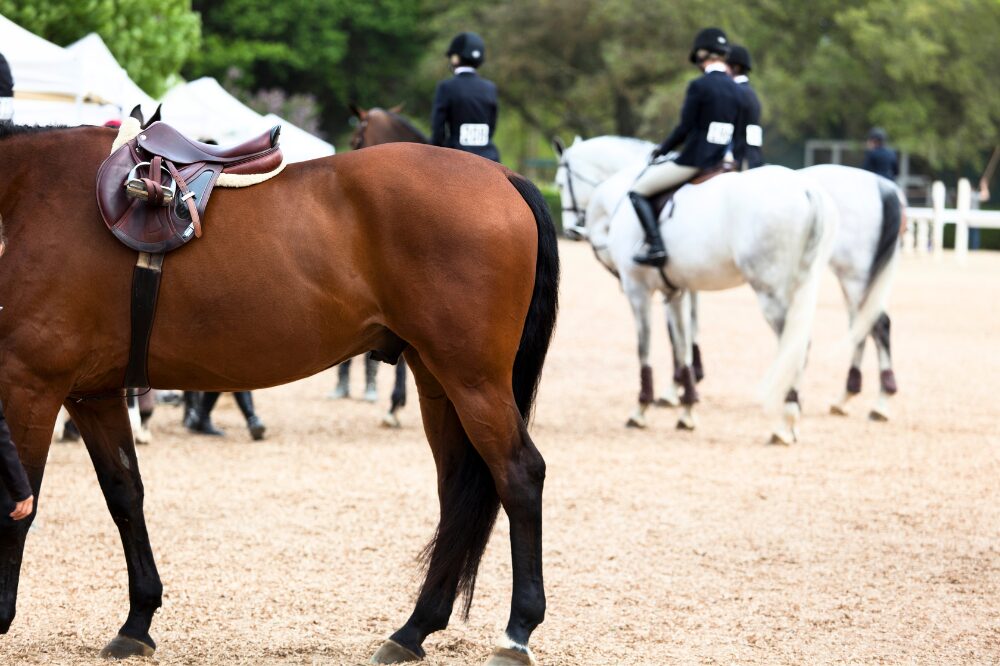
Don’t bring anything home with you except ribbons!
Biosecurity Measures at the Home Barn
There are a few primary situations when you need to implement safety measures, either by establishing biosecurity at horse shows or home barns. One is a sick horse, and the other is when horses come onto the property. Either they are new and moving in, or they have been to a show.
Development of an isolation plan
- Think of an isolation plan as creating two barns instead of the usual one. The physical isolation barn should have:
- Distance from other equines, preferably 200+ feet of distance. If that’s not possible, don’t allow any nose-to-nose contact within the barn or fields. Keep an empty stall as a buffer, or add a solid wall barrier between stalls.
- It’s own set of hoses, buckets, troughs, rakes, manure forks, feed room, and hay storage area.
- A place to change into PPE or add PPE to your outfit to prevent contamination between the two areas of horses. Ideally, your clothing and your hands never touch either area. Coveralls, disposable gloves, and different boots let you have an outfit for each barn.
- It’s own trash and muck tubs or wheelbarrows.
- A routine that allows you to visit one barn and then the other, instead of going back and forth.
Also have:
- A routine that includes taking vital signs of ALL horses, in both areas, at least twice daily. Prevention and early intervention are the backbone of biosecurity at horse shows.
- Signage to indicate an off-limits area.
- A clear list of instructions on what to do if you see any unusual behaviors or record any abnormal vital signs. This may include what vet to call, the owner’s information, and any instructions about alerting the barn owners and manager.
Know Your Horse’s Vital Signs
- You will only be able to detect a change in your horse’s vital signs – heart rate, respirations, digital pulse, and temperature – when you know your horse’s normals. It’s no good if you don’t have that baseline value to compare with.
- During and after shows, check your horse’s vitals twice daily. A fever will show up long before your horse starts to act sick. Early detection also gives the OTHER horses in the barn a fighting chance to avoid infections.
- Biosecurity at horse shows should encompass the entire showgrounds, with everyone playing a role.
The normal vital sign values of horses
- You can easily take your horse’s vital signs in a few minutes. You really only need a thermometer, though a stethoscope is handy for both gut sounds and heart rate.
Temperature – 99.5 to 101.5
For foals, up to 102 is normal.
Pulse (Heart Rate) – 24 to 40 beats per minute, although most are between 32 and 36.
For newborn foals, 80 to 100 is normal, and for older foals, 60 to 80 is normal.
Respiration – 8 to 12 breaths per minute
For foals, 60-80 breaths per minute
Capillary Refill – approximately 2 seconds, gums should be pink
Read more: For step-by-step instructions on taking vital signs.

Frequently Asked Questions

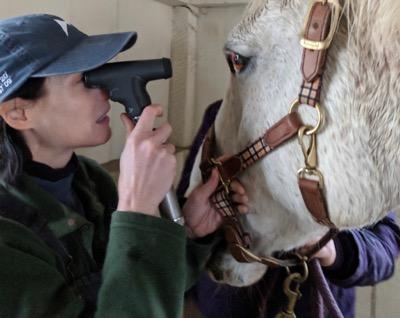
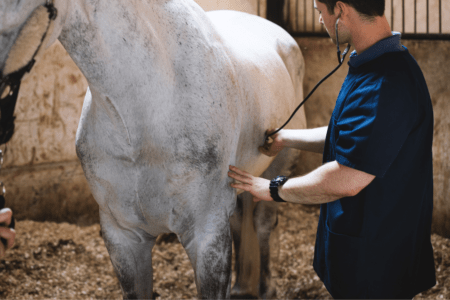
A thermometer is one of the best investments in your horse's health you can use.




References
American Association of Equine Practitioners. (2021). Equine herpesvirus (EHV-1 and EHV-4) guidelines. https://aaep.org/wp-content/uploads/2021/02/Equine-Herpesvirus-EHV-1-and-EHV-4-Guidelines-final.pdf
Equine Disease Communication Center. (n.d.). Equine Disease Communication Center. https://www.equinediseasecc.org/
Merck Veterinary Manual. (2024, January). Vesicular stomatitis in large animals. https://www.merckvetmanual.com/generalized-conditions/vesicular-stomatitis-in-large-animals/vesicular-stomatitis-in-large-animals#Diagnosis_v3274501
University of California, Davis School of Veterinary Medicine. (2020, August 10). Strangles. https://ceh.vetmed.ucdavis.edu/health-topics/strangles
United States Equestrian Federation. (n.d.). Competition safety and biosecurity. https://www.usef.org/compete/resources-forms/competition-management/competition-safety-biosecurity